Danny Sobor
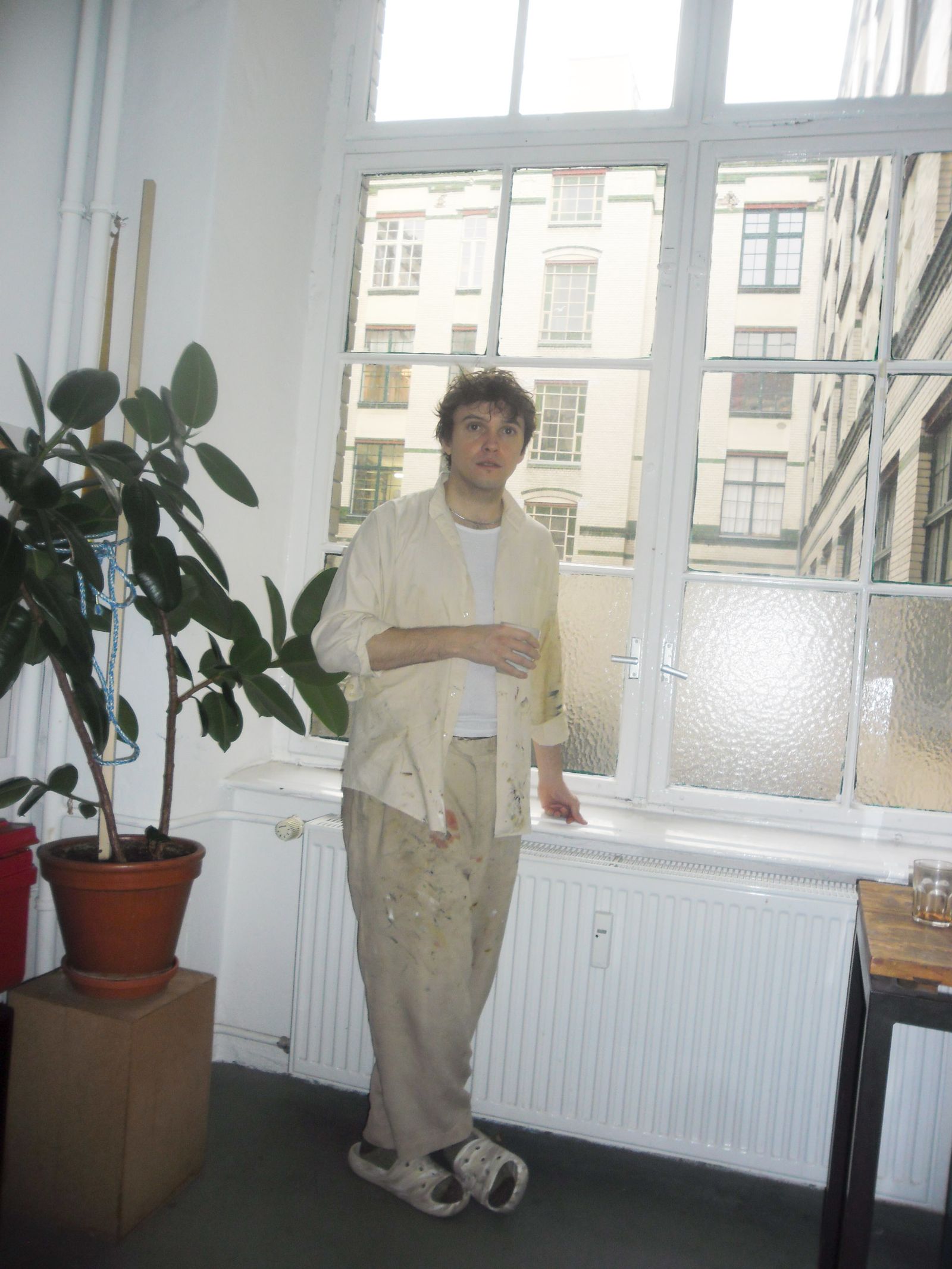
Artist-in-Residence
09.–12.2025
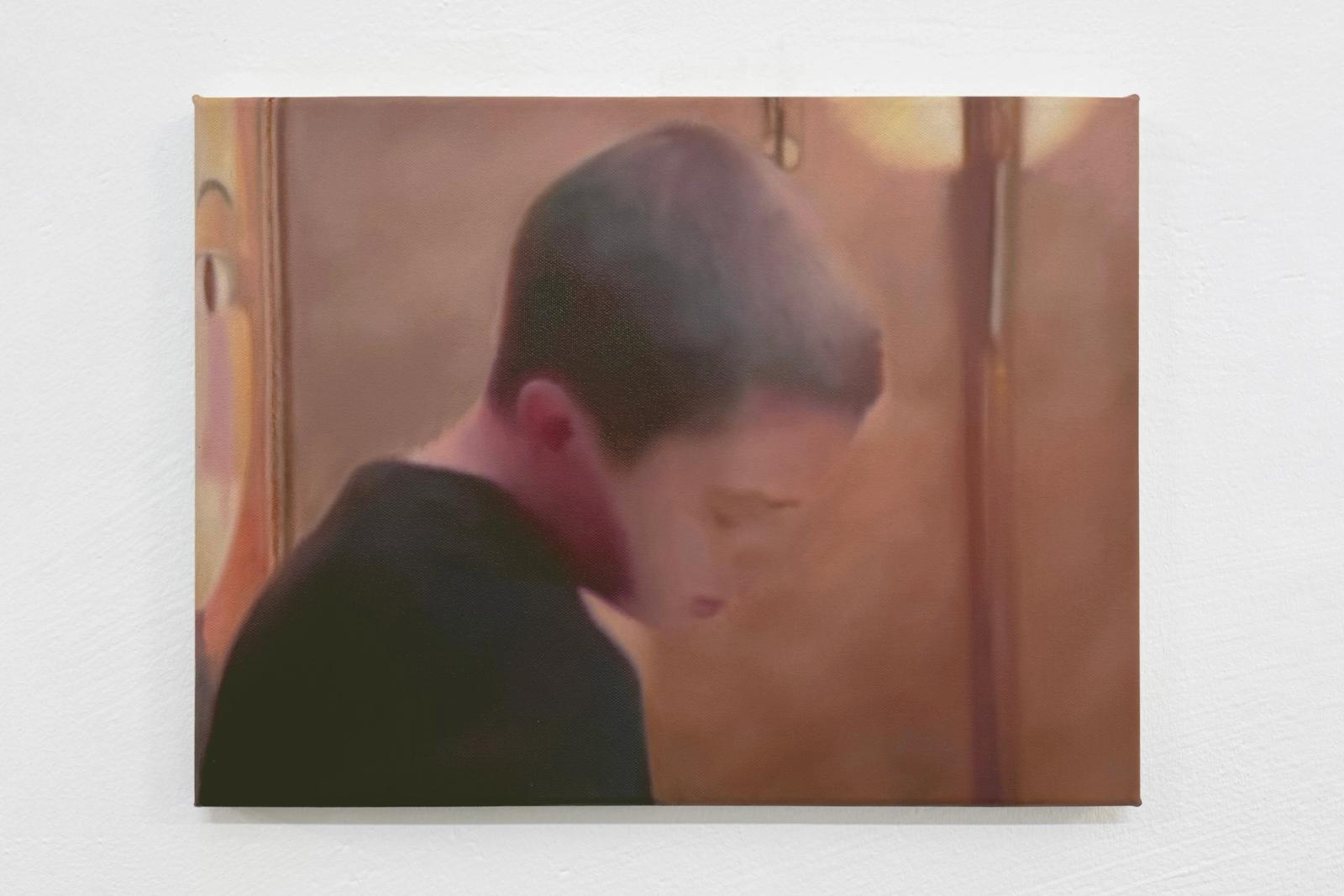
There is a kind of double vision conjured by Danny Sobor's softly painted scenes. Strains of Gerhard Richter and Wilhelm Sasnal wrapped in the dreamlike haze of Andrei Tarkovsky's polaroids combine with the edgy, self-consciously accidental framing of Instagram feeds. Tips of kneecaps, harshly cropped limbs and faces, streaks of light: these images reference the thumbnails of a life posted in ambiguous, moody fragments, as a mixture of selfies and seemingly casual snapshots. Together they tap into the aesthetic of voyeuristic (self-)observation so particular to social media. The resulting paintings are both familiar and distant, representations of the self made strange—a self simultaneously laid bare and concealed by the nostalgia of an amber glaze.
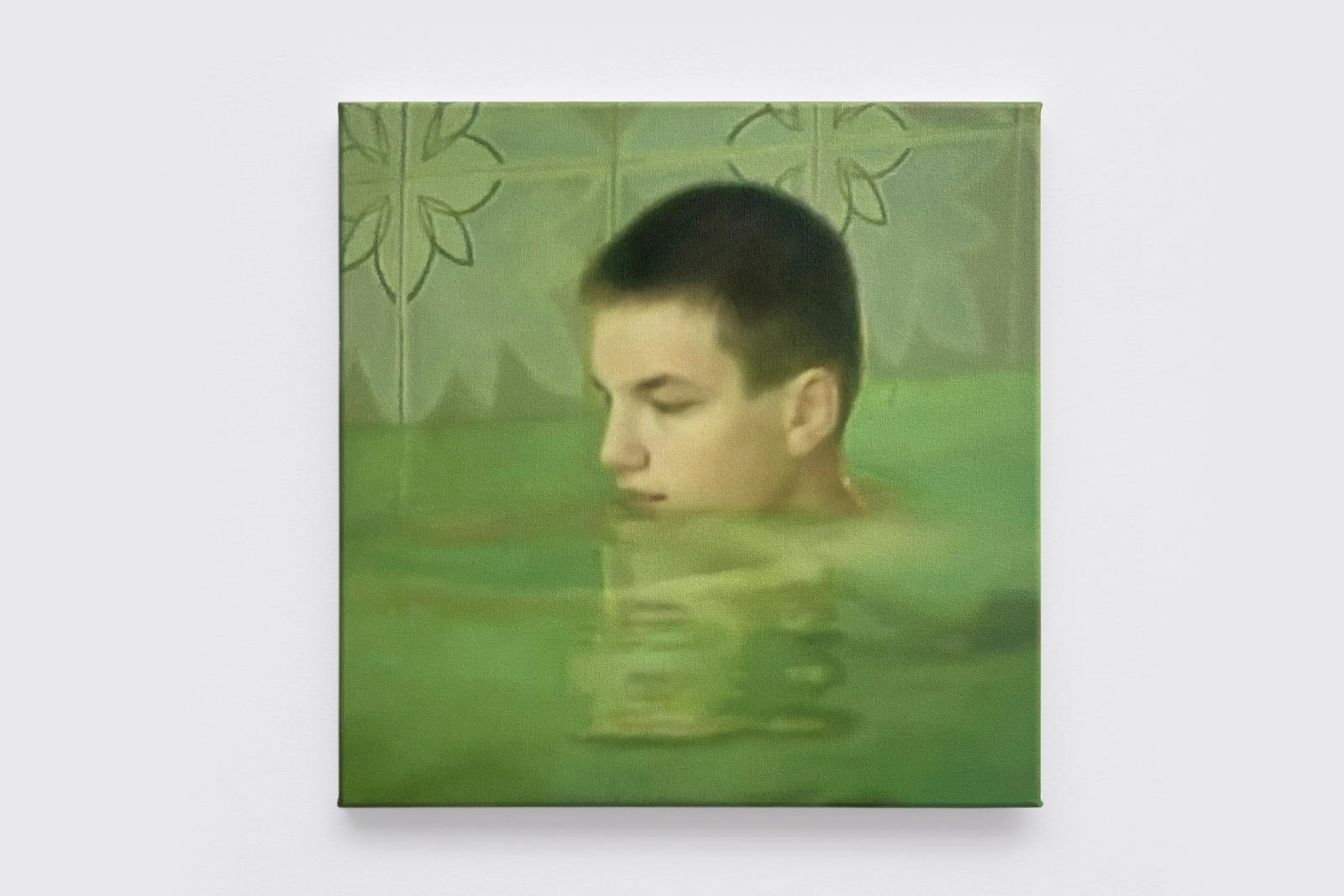
It is no coincidence that this estranged vision reminds me of the spate of “only in Russia” picture blogs in the early 2000s. Sobor sources his images through a Russian search engine, after all. His paintings could be tiny, unassuming extracts cropped from larger photos of derelict Post-Soviet towns populated by forlorn young men with buzz cut hair wearing Adidas tracksuits matched with patterned knit sweaters. These men were often pictured squatting in crumbling parking lots or sitting in small rooms all but swallowed by dingy floral wallpaper. These intractable faces populate Sobor’s paintings, though they appear in close-up against barren beige, or in a particularly slavic version, a green ornately patterned background. The fascination that gave rise to these somewhat ironic websites is nothing new. It is part of a much longer tradition already established through the eastern longings of Rainer Maria Rilke, or Thomas Mann’s eulogizing over the “Russian soul”. It is part of a Western fascination with the “other” Europe—a Europe that serves as something between distorting mirror and crystal ball, alternative future and cautionary tale. When the West looks East, it sees an estranged version of itself.
This estranged self-observation is already embedded in Sobor's biography. Born to anti-communist Polish immigrants who nevertheless decorated their home with revolutionary worker's linocuts, he attended Polish school in Chicago and grew his roots through the recollections and traumas of family. Even before the regime of digital self-exposure, Sobor was observing his American condition and inherited Polish memory as two foreign bodies united in the circumstance of himself. The resulting dislocation, both temporal and spatial, to which he gives form in his paintings, evokes Svetlana Boym's concept of reflective nostalgia, which is not simply a naive longing for a memory made fonder through the lens of time, but a critical, sometimes ironic, lingering on the perpetually deferred meaning caused by a lack of belonging.
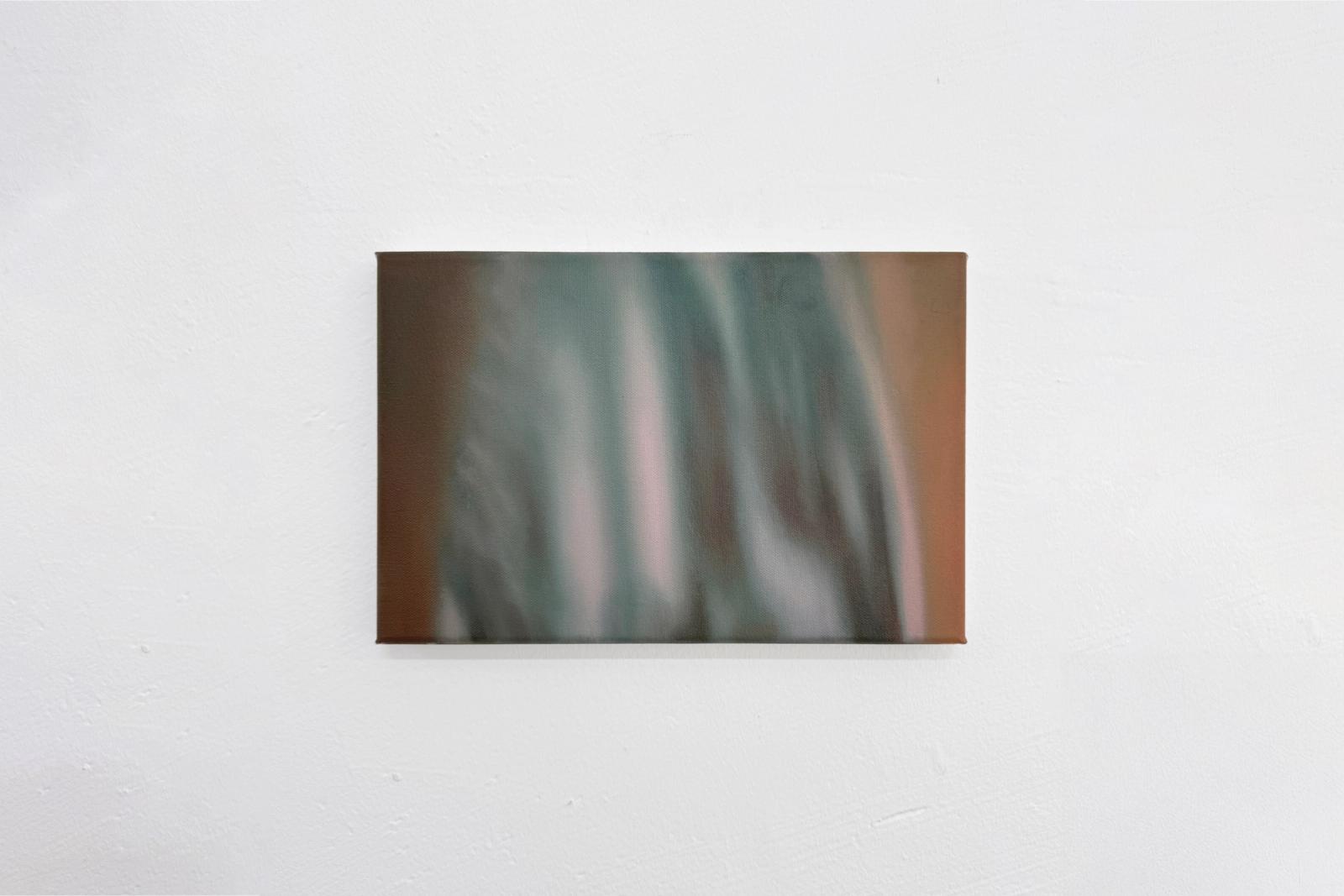
The Russian search engine Sobor uses is called Yandex. He locates his images in temporary archives and hidden directories that sometimes disappear after a few days. This is why he sees the files as “discarded,” especially since he often finds them in states of digital deterioration—the aesthetic of which is reproduced in the blurs, hard crops and ambiguous close-ups of his paintings. The resulting images are caught in the process of becoming ghosts, preoccupied with their own dissolution. In our phone conversation Sobor cites Mark Fisher's “hauntology,” which refers to the futures that didn't happen, and the frustrated yearning for alternatives that is their legacy. The various traces of specificity that punctuate his work, such as palette, style and the odd Eastern European pattern or window frame, refer to a particular type of geographical haunting. Sobor’s parents experienced the cancelled future that was the communist promise. Today the Polish-American artist experiences his reality in the shadow of his parents’ hopes, as a dystopian caricature of a once yearned-for capitalism.
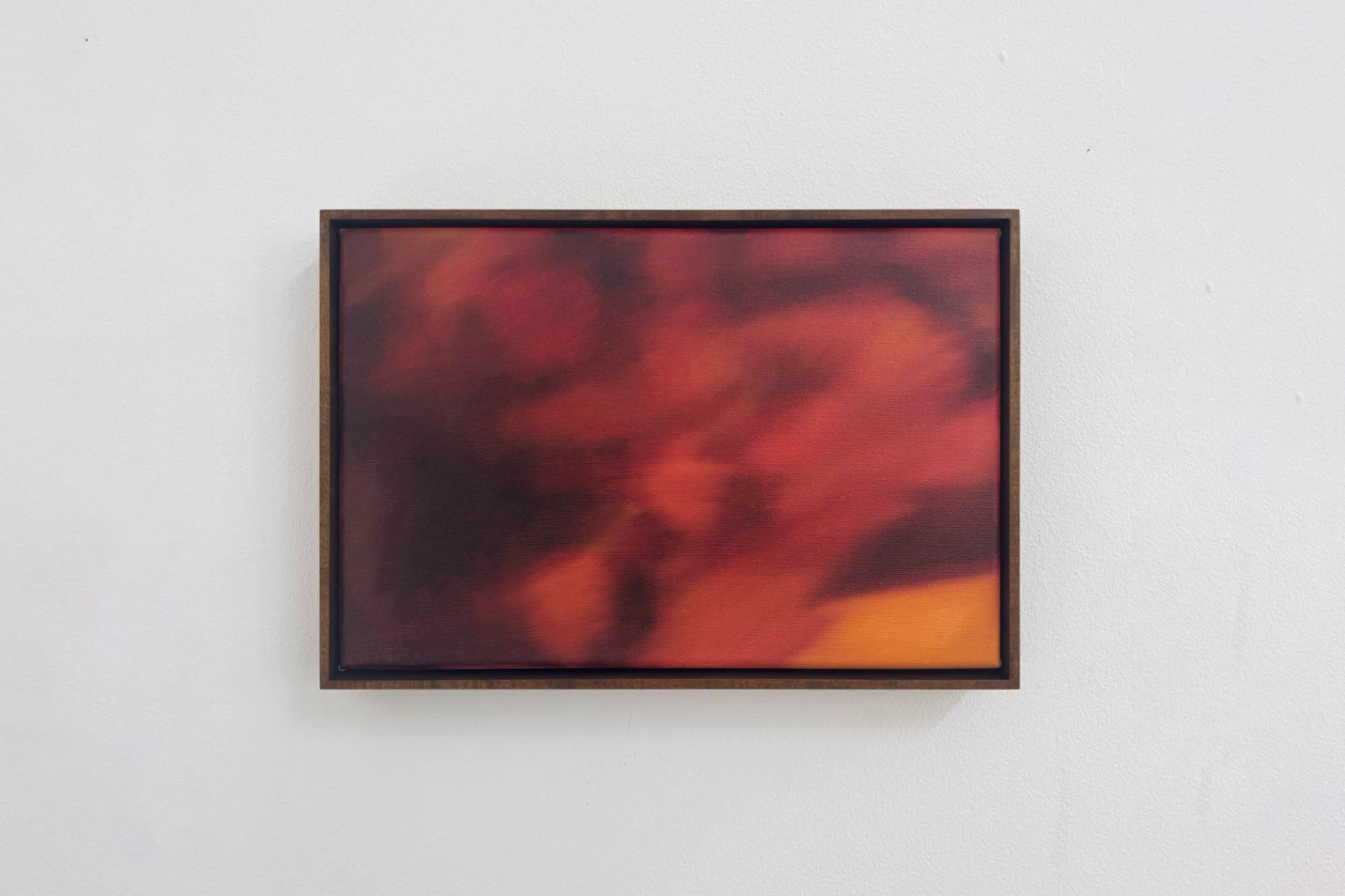
When I ask how much he changes the files he finds on Yandex, he says not much at all. “They are already broken, pixelated,” he explains. “The gap in the data gives me the opportunity to paint. The act of painting them is change enough.” Though he sparingly applies jolts of new synthetic hues—phthalo blue for example—he tells me about his penchant for older colours: ultramarine derived from ancient lapis lazuli, alizarin crimson's heritage in Egypt and Pompeii. In comparison cadmium is fairly young, he points out. It is only 150 years old. When Sobor first started painting, he used his father's paints and brushes, in itself a gesture that situates himself at the forefront of an accumulated past that we, for lack of a better word, call the present. Indeed, the idea that one is the product of a past not necessarily one's own, is a feature of reflective nostalgia. “Immigrants always perceive themselves on stage,” writes Boym, “their lives resembling some mediocre fiction with occasional romantic outbursts and gray dailiness.” (254) Sobor's painting in the gaps is not only a way of situating himself at the threshold of two cultures, but a reckoning with their taken-for-granted realities. The Polish identity of the American-born artist reveals itself to be the construction it always has been, even back “home” where it is naturalised through collective experience. As E.M. Cioran once wrote, in a language not his mother tongue, “The man who belongs, organically belongs to a civilization cannot identify the nature of the disease which undermines it.” (48) Growing up in an immigrant narrative distances one from one's immediate environment, creating an atmosphere of both intimacy and alienation.
Through western eyes, Russia has long been the apex of familiar and strange. It’s through these eyes that Sobor’s eastern perspective is focussed—a perspective oscillating between self and other, situating the subject at the intersection of lived reality, collective memory and imagined geography. The back of a young man's head in a car, the taciturn stare of another in front of a green patterned wall, a woman's apprehensive gaze through a smudged window, a man and woman glimpsing each other through a sheer curtain: these are all images of an alienated relationship between the one looking and the one seen. Direct observation is always deflected by a filmy glaze, a violent crop, a voyeuristic perspective, or just a smudged blur of light. In his Shanghai show at Gallery Vacancy, Sobor accentuated this by dividing the space with soft pinky beige curtains—the most common “skin” colour in the world of make-up. Viewpoints were cut off, the feeling of privacy was heightened, an aesthetic of looking without being seen, or maybe being observed while looking, predominated. An unsettled loneliness haunts the images, especially of the young men, who come across as a hybrid of the razored, tracksuit-wearing eastern hooligan and the mulish, suburban American bro. They look vulnerable and volatile, violent and injured, a figure of the old-new masculinity that I remember in the “only in Russia” blogs. Now, in 2026, they might be the faces of Russia's canon fodder in its continued full-scale invasion of Ukraine. Or they might be hired trolls typing disinformation in comment threads, or the faces of men looking into screens on the other side of the ocean—the frat boys, the bullied and the bullies, the incels of the distinctly American abyss. In Sobor's paintings, just as the obscured gazes of his partial figures never really meet, the gaze of the viewer is always deflected by one distortion or another. In one particularly poignant combination, two small, softly focussed paintings hang side by side, both are close-ups of an individual's eyes. The young man is seen from the profile, looking down, the woman's eyes are looking up, punctuated by a glint of moist, white light. Titled respectively “look down” and “look up,” these two figures are beside each other, yet impossibly far apart. The veil, the emptiness and avoidance that hangs between man and woman, hangs also between East and West, here and there, viewer and image.
Sobor's paintings, even in their mantle of nostalgia, tie into the present moment. They are the ghosts of images reflecting us in their digital uncanny. “Strangely,” writes Julia Kristeva, “the foreigner lives within us: he is the hidden face of our identity, the space that wrecks our abode, the time in which understanding and affinity founder.” (265) If that's the case, which I believe it is, and I believe Sobor thinks so too, then it is an opportunity to face our own strangeness, the gaps in our data, and craft means of connection beyond the illusion of belonging.
Text by Dagmara Genda Portrait by Erik Sæter Jørgensen