Dylan Solomon Kraus
Artist-in-Residence
08.–12.2025
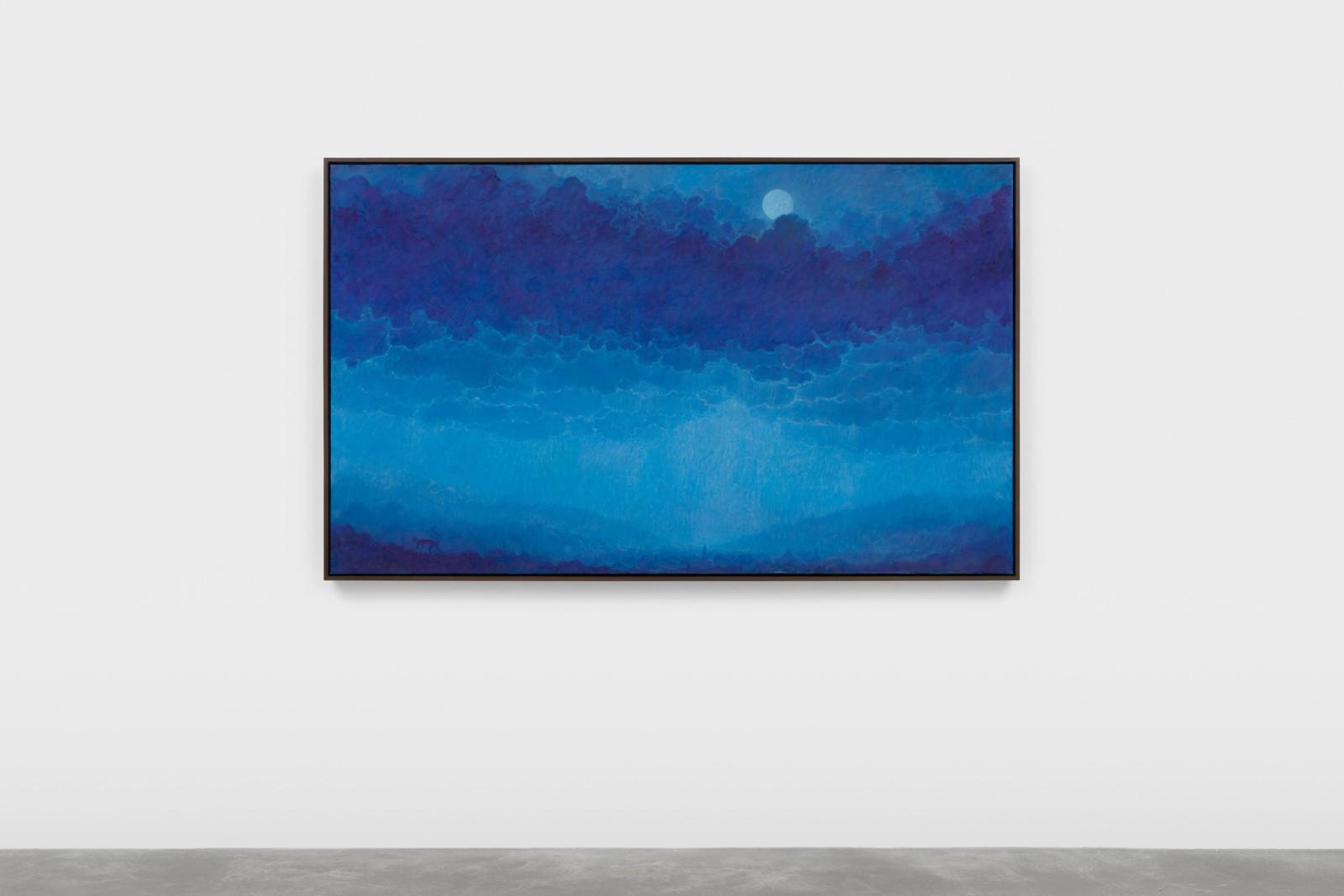
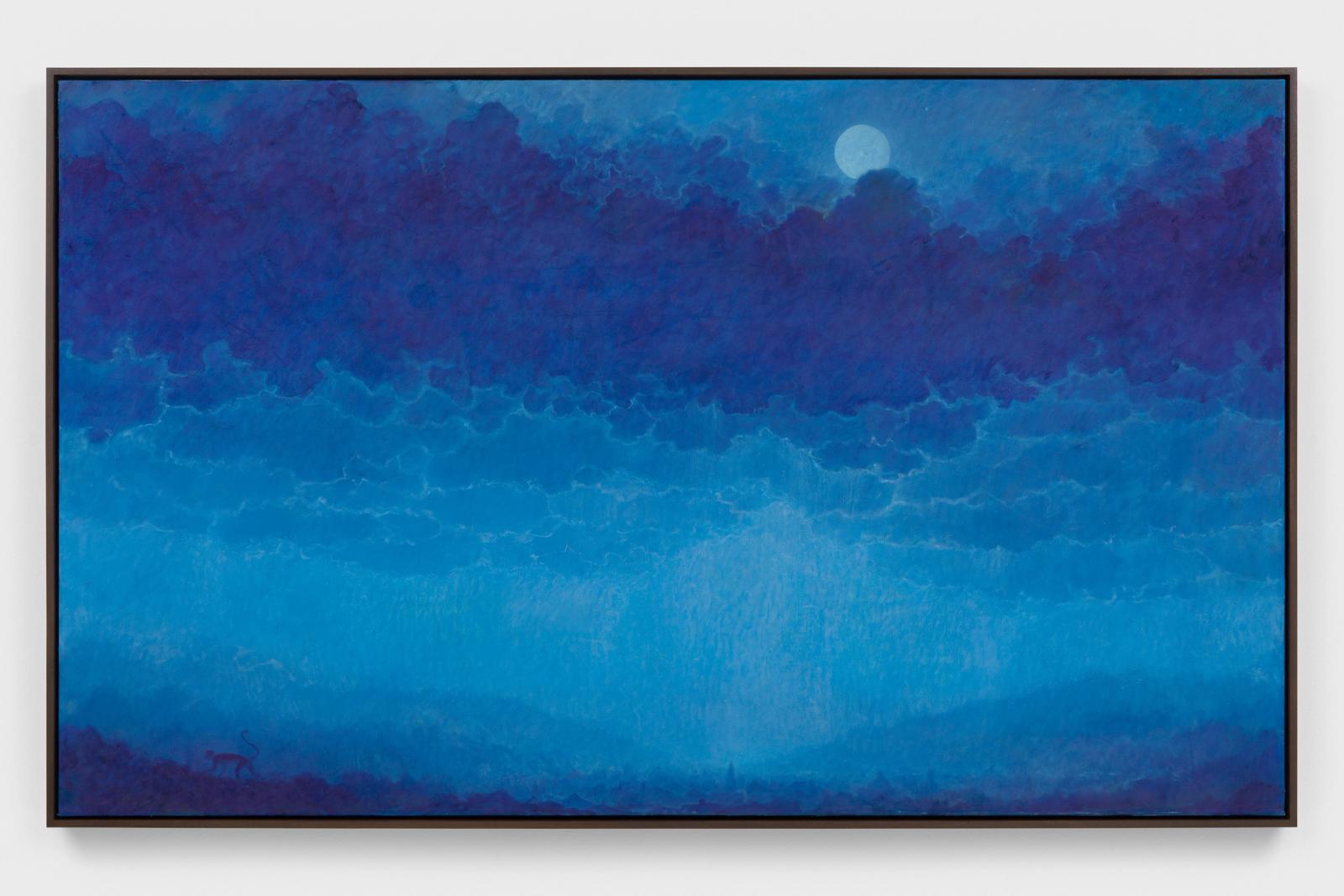
The night before it had snowed, and this morning I was standing at the windows in my parents’ living room trying to guess which animals had laid the tracks in their backyard. I had seen squirrels, possums, raccoons, and deer (was told there were rabbits), but at present they were all absent except for a bird at one of the feeders. It made me think of one of my favourite pieces by Dylan Solomon Kraus—a pink, black, and purple painting of a bird on a tree branch below the moon. The artist had once told me, when I said something about the Zen-like nature of his work, that the night is always dangerous. But this bird, held tightly in its snowy backdrop, felt safe.
On my bike ride over to visit Dylan at his studio for the first time, I remember that the worlds of his paintings had already started to trick their way onto mine. Behind the clouds over Kottbusser Damm, just past the eye’s view, hid one of his cities in the sky. I had been rereading Invisible Cities by Italo Calvino—a book filled with vignettes of imagined, increasingly improbable cities—with the hope of finding a way to speak to Dylan about his work. I told him about the book and about how I thought that one of his paintings could have easily been the cover art for it. I took a seat on the couch, leaving Dylan and his two large paintings on the far side of the studio. Across the floor, and crawling up the wall like ants, were small square compositions of city skylines, some with a moon holding overhead. In one, there was a teapot as big as a pumpkin right in the foreground. I told Dylan there was a quote from the book that made me think of his work. I read it from my notebook:
“I saw from a distance the spires of a city rise, slender pinnacles, made in such a way that the moon on her journey can rest now on one, now on another, or sway from the cables of a crane.”
In the days that followed, I wrote down lines and wordings I liked: “a swan breaks its reflection,” “arabesques give way to wide pushes of wind,” “portals,” “collective ineffability,” “objective correlative,” “the night is always dangerous.” I tried to focus on Dylan’s work, on what I would say about it, but I couldn’t help fixating on the overwhelming sense of placidity in his studio that day. All my movements—sitting down on the couch, flipping through the pages of my notebook—had seemed to produce too much noise, too much commotion. There was a kind of balancing act happening between Dylan and his paintings and I had been stuck in the middle of it.
I remained attached to Invisible Cities, hopeful that in it was a key or a framing or perhaps a question I hadn’t gotten around to asking. This quote kept coming back to me:
“You walk for days among trees and among stones. Rarely does the eye light on a thing, and then only when it has recognized that thing as a sign of another thing: a print in the sand indicates the tiger’s passage; a marsh announces a vein of water; the hibiscus flower, the end of winter. All the rest is silent and interchangeable; trees and stones are only what they are.”
Weeks later, I found myself standing in front of Caspar David Friedrich’s Monk by the Sea at the Alte Nationalgalerie in Berlin. It was here that I surrendered myself to the idea that I was more of a kaleidoscope of references than someone with singular insight. I tried to imagine a woven blanket but could never, in my mind, make the fabric resemble something like wool. What I saw instead reminded me of the collages children make by interweaving strips of paper. Then I decided that a kaleidoscope of references was a unique perspective, and I remember a warm feeling settled over me.
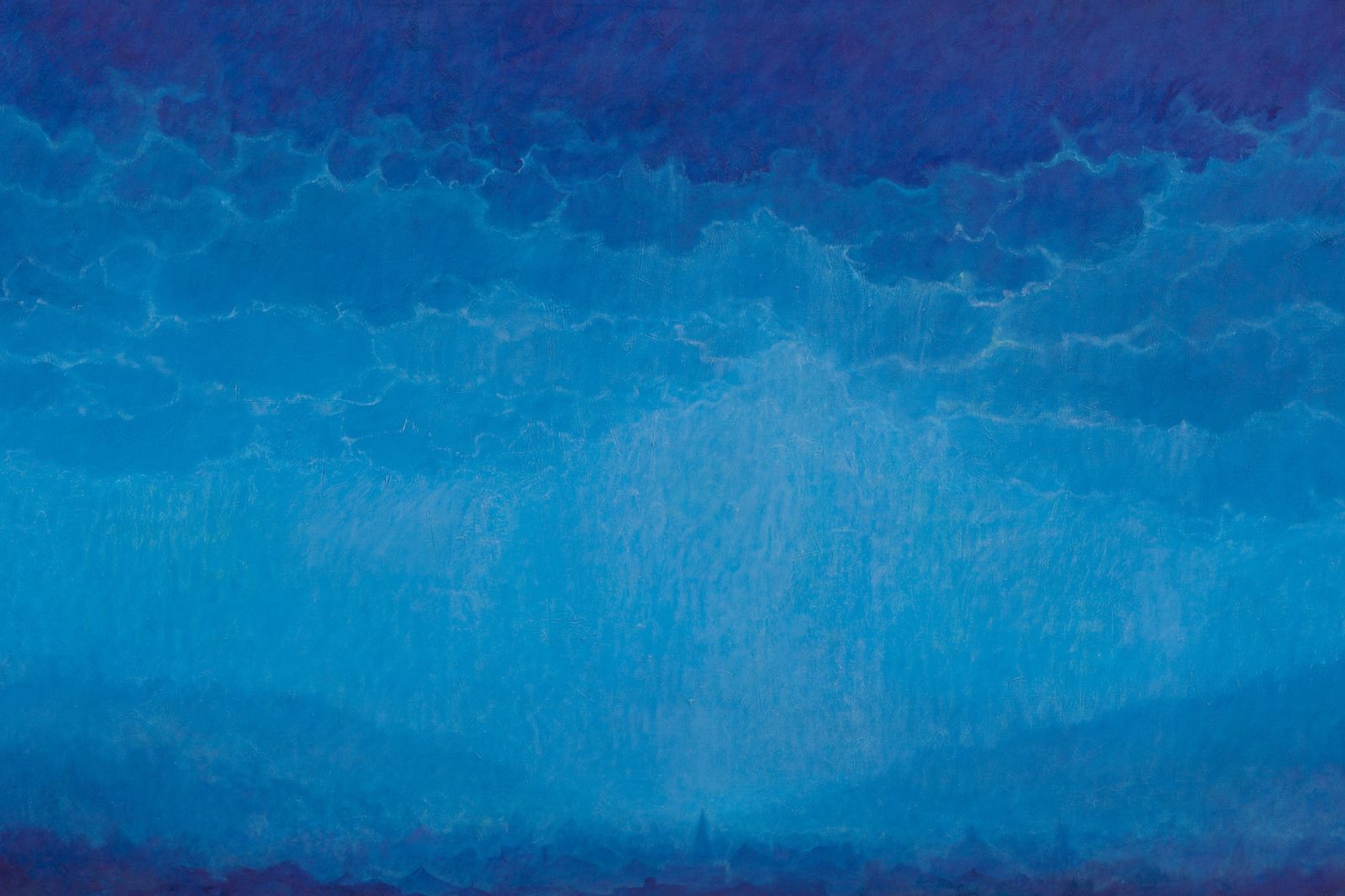
I returned to Dylan’s studio. The two large works-in-progress, which on my first visit were black and purple and resembled nebulas, were now set in all of Dylan’s shades of blue, yet all their nebula-ness remained. In Monk by the Sea, Caspar David Friedrich’s bands of clouds, sky, and sea blend together yet follow some kind of path, some kind of direction. At the horizon, the clouds come together into something like a storm, but the higher the eye travels, they slowly part in wisps and leave something like the perfect spring morning at the top of the work. It is big, hopeful, angelic, and linear. I had seen so much of Dylan in it. And I too felt big, hopeful, angelic, and linear now that I had found a way to speak about his work. But something shifted in me.
Dylan’s clouds and seas and skies, rolling together, were antithetical to Monk by the Sea. They were like a kite flying on a rainy day or an atomic bomb being detonated underwater. I started to see less safety in his work. When there is a butterfly or moth, there is a bird. A solitary animal has only the moon, the sky, infinity as its friend. Stars lose their reality and become the colored five points of childhood. The swan breaks its reflection—had it thought it was not alone? The feeling contaminated my perception further. Monk by the Sea came into my purview and veiled my eyes like a nightmarish image. I searched for the painting online and zoomed in on the monk. His gaze appeared fixed on the storm at the horizon. He was either unaware or unmoved by the clouds clearing above him.
Some months later, I was standing in front of the two large works again. All the soft lines of clouds and sky, sea and city, had developed into rigid Escheresque lines. Any ambiguity in the direction of it all had been set into a labyrinth of Dylan’s making. Blooms of light and dark clouds, the city and landscapes below, all seemed to fight each other for the moon and sun’s illumination. At the bottom left corner of one of the large works, a tiny monkey had appeared. The monkey seemed to be escaping from the city above. Dylan told me that there had been circus tents there—I remember he waved his hand toward the bottom half of the canvas—but that he had decided to remove them.
I didn’t think much of the monkey when I first saw it. That night after my final visit, I walked down the street thinking about Dylan’s work. I remember my mind went to that deep register of framing, which I was finding more and more difficult to escape. I thought about the stupor of that first time in the studio. The new rigidity in the clouds. Light and dark—illumination. Then something shifted and I was only thinking about the monkey.
Invisible Cities was back on my shelf. I started to think about another book by Clarice Lispector, The Passion According to G.H. It was Christmastime, and I was heading back to the States. I threw it in my bag. By this point, I think I had stopped thinking about the monkey and settled back into the trance-like state of my first visit. I realized at some point why I had brought the book home with me. There was a quote in it I had always loved but had not thought about for years. And then, sitting at my parents’ dining room table, I had it in front of me:
“Everything could be fiercely summed up in never emitting a first scream—a first scream at birth unleashes a life, if I screamed I would awaken thousands of screaming beings who would let loose upon the rooftops a chorus of screams and horrors.”
I looked up and there, through a window in the living room, a deer was staring at me. We held the stare for too long. The deer then put its head down and sauntered away. I stood up from the table and walked over to the window. I needed to see its tracks in the snow.
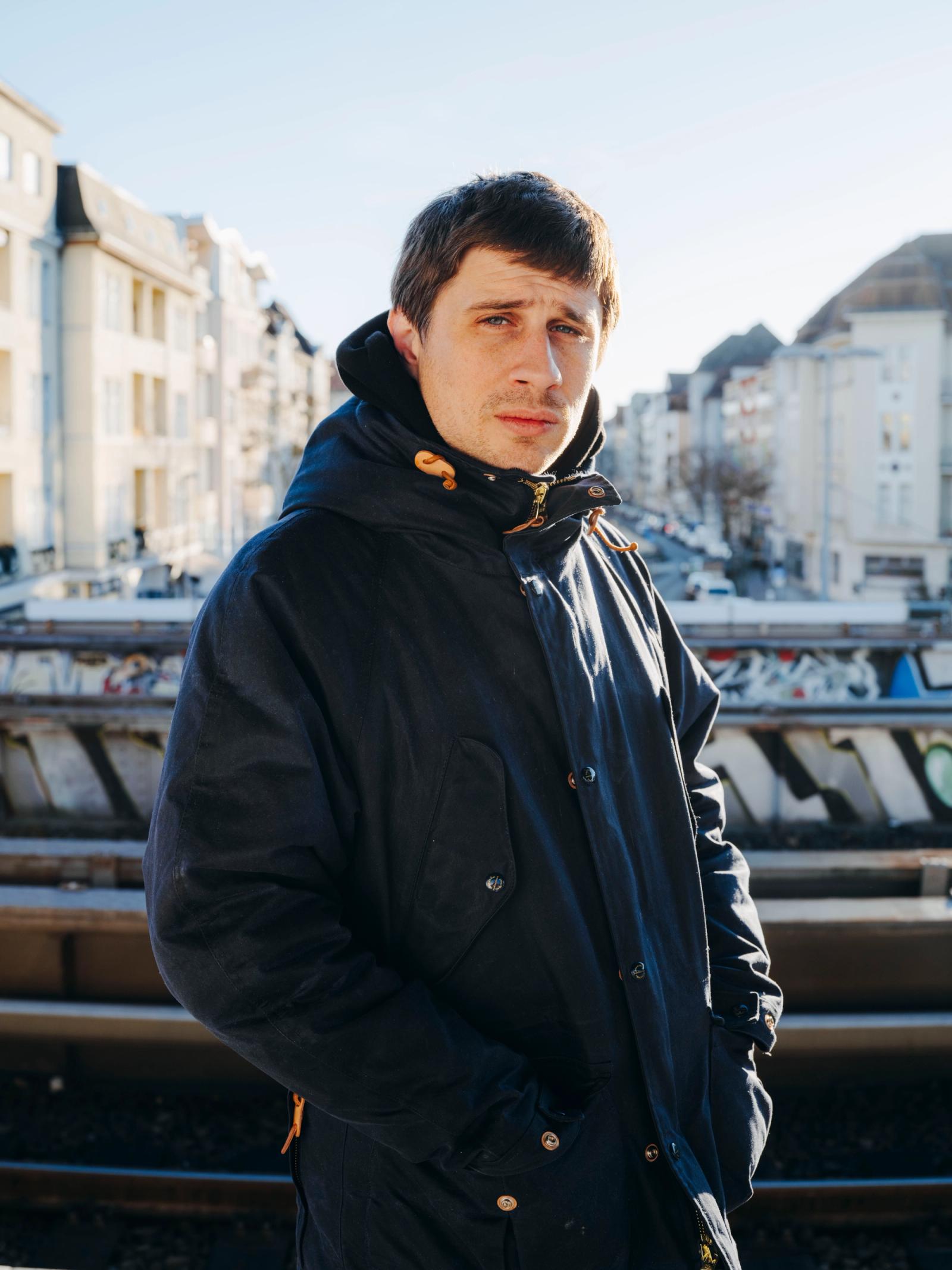
Text by David Torrone Portrait by Katharina Poblotzki